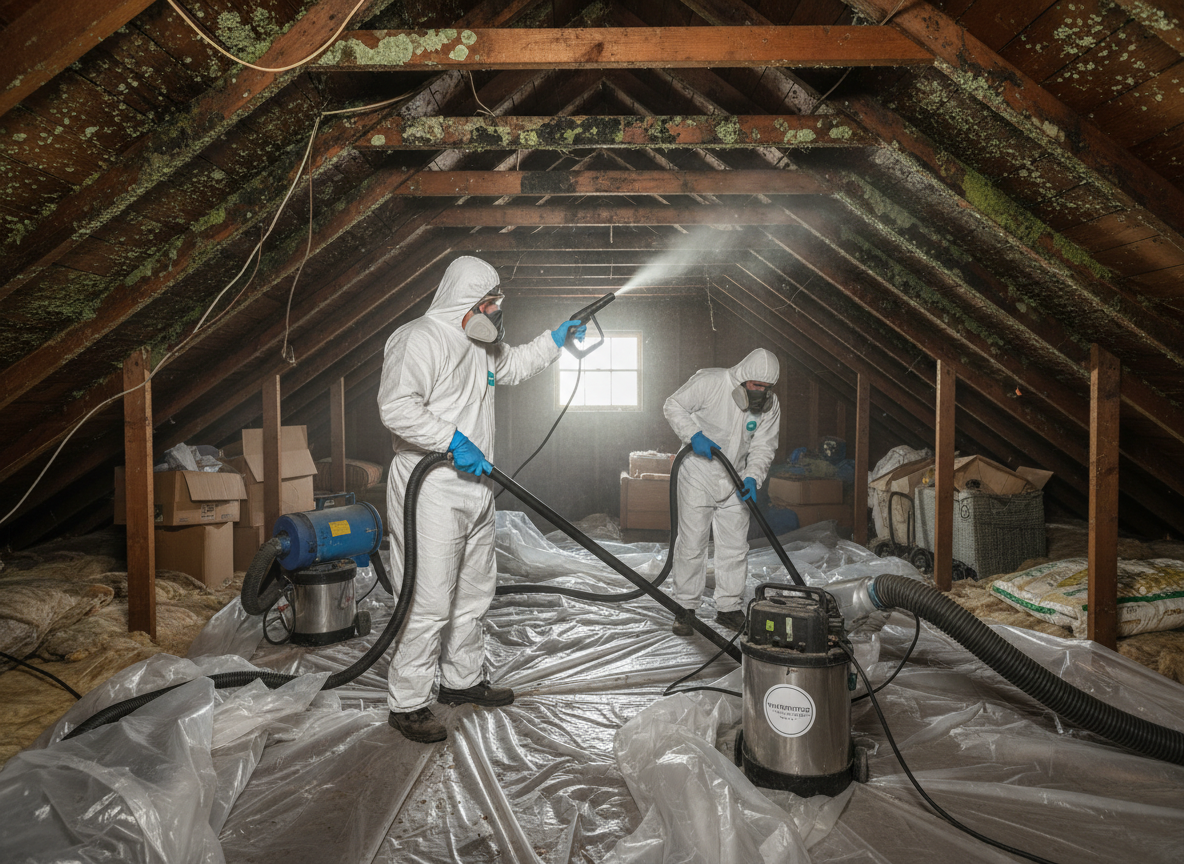
Attic mold in Whitewater often starts from small roof leaks that go unnoticed until summer temperatures push the attic into triple digits. The extreme heat dries surface moisture quickly but leaves spores embedded in fiberglass batts and older cellulose insulation common in homes built before the 1990s along Dillon Road and toward Banning. Removing only visible growth without pulling and replacing affected insulation usually leads to recurrence within one monsoon season.
Access is the first real constraint. Many Whitewater attics have low clearances and limited ridge vents, so technicians must cut additional entry points while protecting HVAC ducts that run through the space. We bag and remove contaminated material through exterior chutes to avoid spreading spores into living areas, then treat wood sheathing with EPA-registered antimicrobials before installing new insulation that meets current Riverside County energy codes.
Edge cases appear after flash flooding from the Whitewater River washes debris against foundation walls and drives moisture upward into knee walls. In these situations we combine attic work with perimeter drainage checks so the same water path does not re-wet the ceiling plane. Homeowners near Palm Springs who added solar panels often find mold concentrated around new penetrations where flashing was never properly sealed.
Final clearance testing uses both air sampling and surface swabs because desert dust can mask readings. We leave the attic under negative pressure for 48 hours after treatment and document moisture levels in the sheathing so owners know when it is safe to re-insulate.
Technician insight
In Whitewater, the thing that catches most people out with attic mold remediation is how the extreme summer heat bakes spores deep into older cellulose insulation in homes between here and Banning; surface sprays alone never reach it and the job always requires full removal.
Hidden Leak Under Solar Array
A Whitewater homeowner noticed dark spots on bedroom ceilings after monsoon rains. Inspection revealed water tracking under recently installed solar panel mounts that lacked proper flashing. We removed 180 square feet of saturated insulation, treated the rafters, and confirmed clearance readings before the owner reinstalled new insulation.
How it works
- 1
Initial Inspection and Moisture Mapping
We enter the attic from outside access points, map all wet areas with infrared and pin meters, and identify the water source before any removal begins.
- 2
Containment and Air Filtration
Plastic sheeting and negative-air machines isolate the attic from the rest of the home while HEPA filtration runs continuously.
- 3
Removal of Affected Materials
Contaminated insulation and drywall sections are double-bagged and removed through exterior chutes; wood surfaces are cleaned and treated.
- 4
Drying Verification and Final Testing
We confirm moisture content has returned to safe levels, run clearance sampling, and provide a written report before reinstallation.
Pricing
Cost depends on attic size, depth of insulation removal, and whether additional roof repairs are needed before insulation can be replaced.