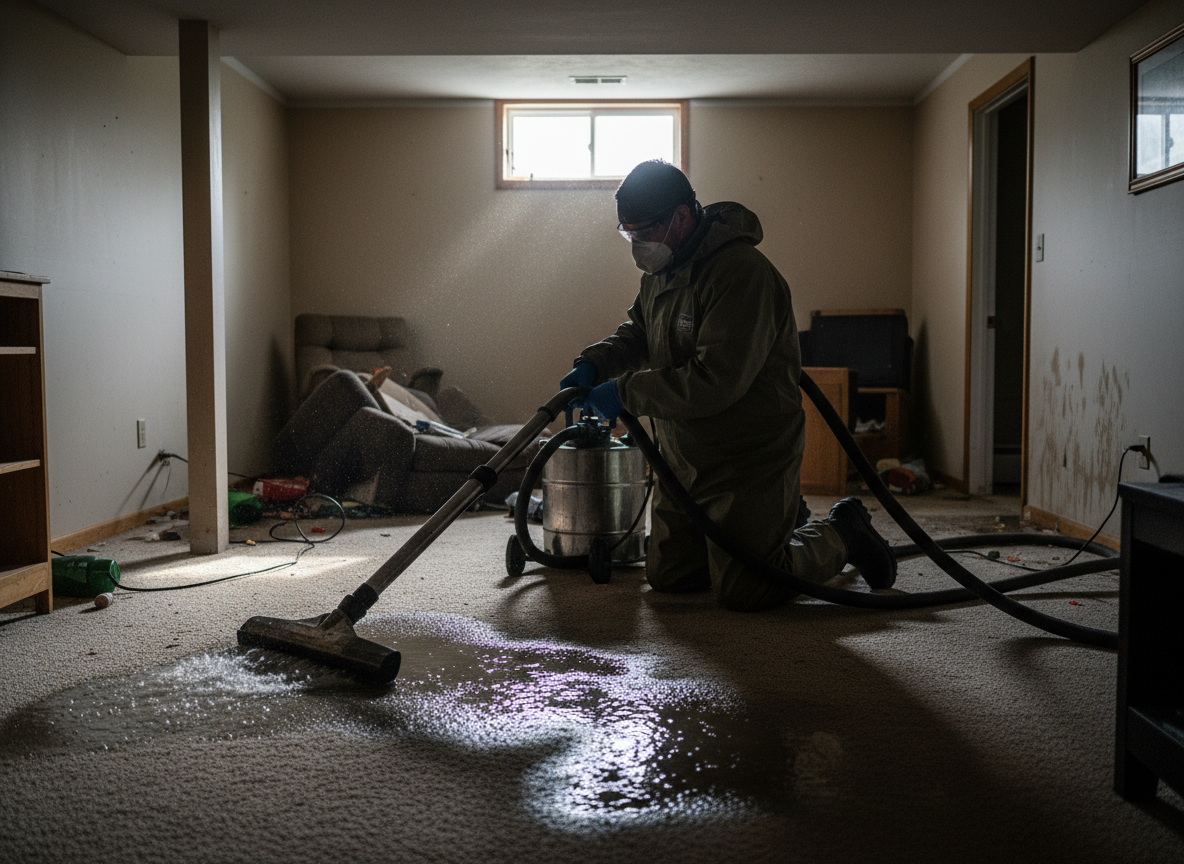
Whitewater sits in a hot desert climate where summer temperatures regularly push past 110 degrees. Surface water evaporates fast, but that same heat drives moisture deep into stucco, drywall, and slab foundations common in homes built from the 1960s onward. Extraction crews must pull standing water before it migrates into wall cavities or under tile, especially in neighborhoods along Dillon Road and toward Banning where older single-story ranches sit on flat pads with minimal grading.
Flash flooding from monsoon storms or irrigation canal overflows often leaves water trapped against concrete stem walls and in crawlspaces. Technicians use truck-mounted extractors and submersible pumps sized for the volume, then follow with moisture meters to locate pockets behind plaster and under cabinets. In Palm Springs-adjacent properties with gravel lots, crews also watch for water that has wicked into perimeter soil and threatens to re-enter through slab edges once the visible puddle is gone.
Extraction work here differs from coastal jobs because rapid surface drying can mask ongoing saturation in insulation and subfloors. Crews document moisture readings at multiple depths before and after each pass, then set drying equipment only after bulk water removal is complete. Homes near the Whitewater River wash require extra attention to sediment-laden water that leaves behind fine silt inside wall voids and HVAC returns.
Technician insight
In Whitewater, the thing that catches most people out with water extraction is how fast the extreme summer heat dries the surface while leaving silt and moisture trapped behind stucco and under tile in 1960s-1980s homes along Dillon Road and toward Banning.
Crawlspace extraction after monsoon runoff
Water from a monsoon storm entered a single-story home near the Whitewater wash. We found several inches of sediment-laden water under the floor. Pumps removed the bulk volume, meters located saturation in the perimeter walls, and extraction continued until readings dropped. The home avoided secondary damage once hidden pockets were addressed.
How it works
- 1
Arrival and Safety Setup
Technicians park at the 60735 Dillon Rd base or respond directly, then isolate power and gas while protecting unaffected rooms with plastic barriers.
- 2
Standing Water Removal
Pumps and extractors pull visible water from floors, carpets, and low areas, with attention to crawlspaces common under Whitewater ranches.
- 3
Hidden Moisture Detection
Meters check walls, cabinets, and slab edges for trapped water driven deeper by desert heat before any drying equipment is placed.
- 4
Final Extraction Pass and Documentation
Remaining moisture is pulled, readings are logged, and the site is left ready for drying or mold-prevention steps if needed.
Pricing
Pricing depends on water volume, access to crawlspaces or slab edges, and how far moisture has traveled in the heat.