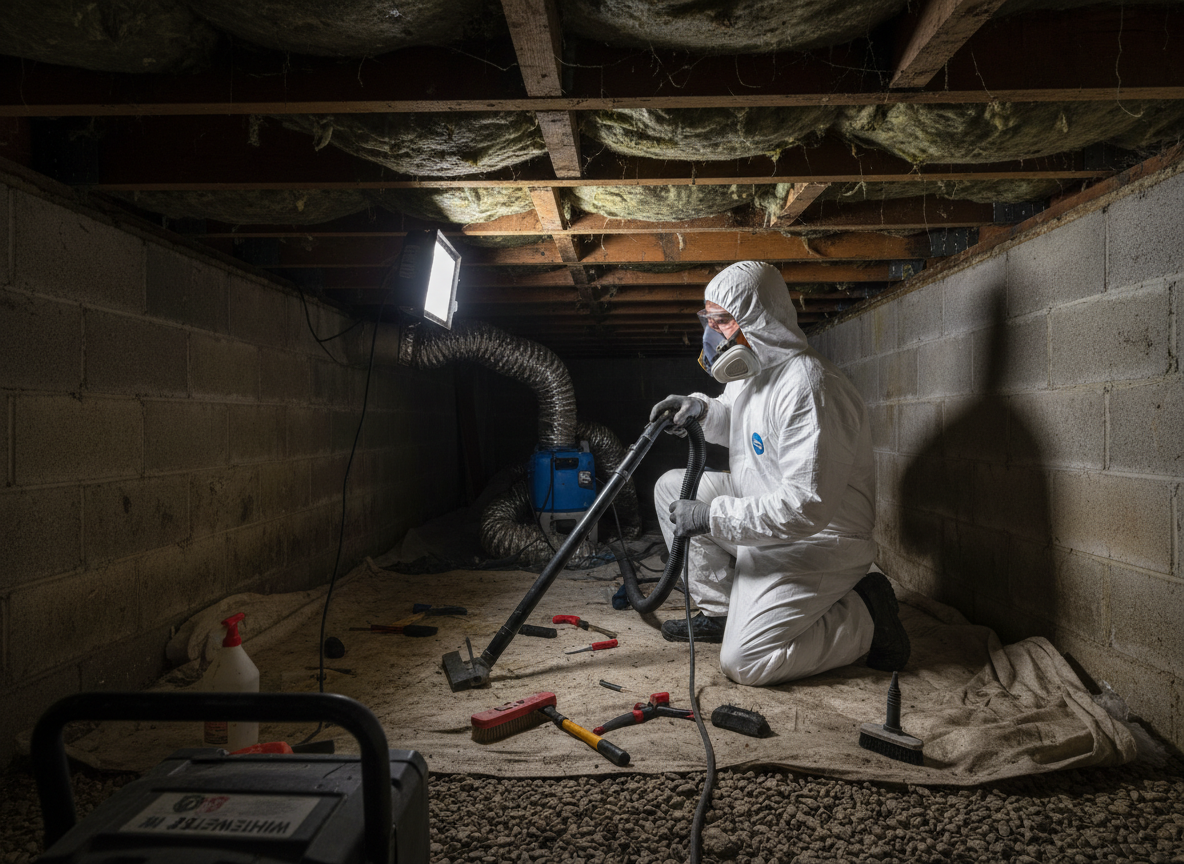
Whitewater sits in Riverside County where hot desert summers push temperatures well above 100 degrees and force homeowners to run irrigation systems heavily for landscaping. Those systems often leak under older slab or pier-and-beam homes common along Dillon Road and toward Banning. Moisture collects in crawl spaces with limited airflow, allowing mold to grow on joists and insulation even when the surface air feels bone dry. Removing the mold requires sealing off the space, using negative air machines rated for fine spores, and disposing of saturated insulation without spreading particles into living areas.
Access in Whitewater homes is frequently tight because many properties built before the 1990s have low clearance and rocky soil that holds pockets of water after rare heavy rains. Technicians must wear full PPE and use HEPA vacuums plus antimicrobial rinses approved for wood framing. Simply spraying bleach fails because it does not address the root moisture source or penetrate deep into the lumber. After removal, crews install vapor barriers and improve ventilation to prevent recurrence during the next irrigation cycle or monsoon season.
Edge cases include mold that has spread to HVAC ducts routed through the crawl space, a common setup in Palm Springs-adjacent neighborhoods. In those situations the entire duct run must be cleaned or replaced to avoid blowing spores into bedrooms. Local building practices also mean some homes have post-tension slabs with limited entry points, requiring temporary excavation or additional ports. Homeowners who attempt DIY removal often disturb the mold without containment, pushing spores into the attic or walls where summer heat then accelerates growth.
Technician insight
In Whitewater, the thing that catches most people out with crawl space mold removal is how fast irrigation leaks under the house combine with 110-degree summer heat to bake spores into the joists before homeowners notice any musty smell upstairs.
Irrigation Leak Mold Discovery
A Whitewater homeowner noticed rising humidity in one bedroom during July. Inspection revealed a cracked irrigation line soaking the crawl space soil under the pier-and-beam section. Crews contained the space, removed saturated insulation, treated the joists, and installed a new vapor barrier. The bedroom humidity dropped and no further mold growth occurred after the line was repaired.
How it works
- 1
Initial Assessment
Technicians enter the crawl space from the 60735 Dillon Rd base to map moisture sources and visible mold using moisture meters and borescopes.
- 2
Containment Setup
Plastic sheeting and negative air machines isolate the crawl space so spores do not migrate into living areas during removal.
- 3
Removal and Cleaning
Affected insulation and wood are removed, surfaces are HEPA-vacuumed, and antimicrobial treatments are applied to framing.
- 4
Drying and Prevention
Dehumidifiers and air movers dry the space, followed by installation of a sealed vapor barrier to block future moisture from irrigation or rain.
Pricing
Pricing varies by crawl space size, depth of mold, and whether duct cleaning or insulation replacement is required.