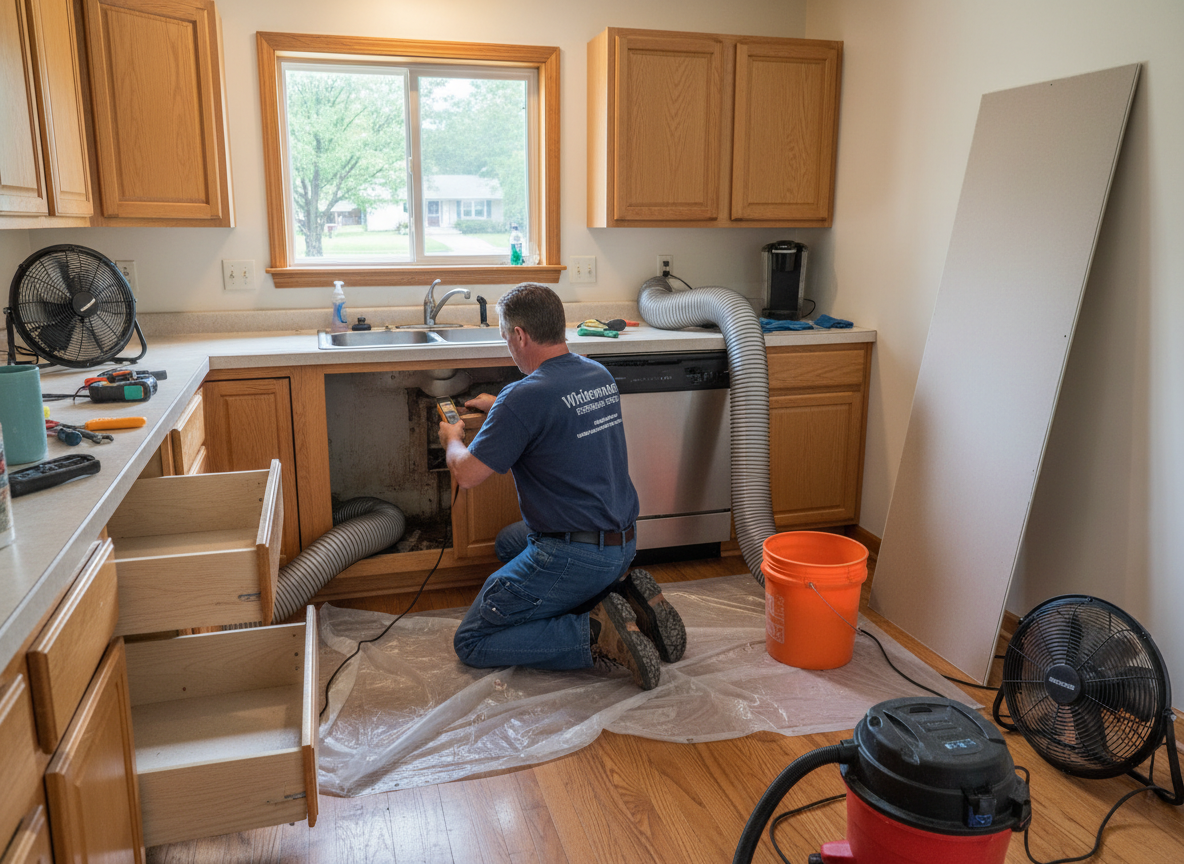
Whitewater kitchens often sit in homes with older cabinetry and laminate or tile floors that sit directly on concrete slabs common in Riverside County builds. When a sink or dishwasher leaks, water travels fast under toe kicks and into particleboard bases because the hot desert climate pulls surface moisture away quickly while leaving deeper saturation. Technicians must pull baseboards early and use moisture meters on the slab to find pockets that would otherwise turn into mold within days during 110-degree summer stretches.
Extreme heat also changes drying strategy. Dehumidifiers run harder here than in coastal zones because ambient air already holds little moisture, so technicians focus on directing airflow into wall cavities behind refrigerators and dishwashers rather than broad room drying. In neighborhoods around Dillon Road, sandy soil under many slabs means water can migrate laterally toward the foundation, requiring perimeter checks that are not always needed in denser Banning soil types.
Edge cases include post-1980s homes with PVC drain lines that crack at joints under repeated thermal expansion, sending water into subfloor insulation. Code requires proper slope on new drain repairs, and crews must verify that any replaced underlayment meets current fire-rated standards when cabinets are reset. Homeowners who attempt their own cleanup often miss the space between the dishwasher and the wall, allowing hidden growth that surfaces weeks later when temperatures spike again.
Technician insight
In Whitewater, the thing that catches most people out with Kitchen water damage repair is how the extreme summer heat bakes the surface dry while water stays trapped under particleboard cabinets and along the slab edge, especially in homes along Dillon Road where sandy soil lets moisture travel sideways.
Dishwasher Leak Behind Cabinets
Water from a failed dishwasher valve had run under the toe kick and into the particleboard base in a Whitewater kitchen. Extraction and daily drying in the desert heat stopped mold before it spread to adjacent drywall. Cabinets were rebuilt in place and the floor section replaced without removing the entire run.
How it works
- 1
Initial Assessment
Technician arrives within hours, maps all wet materials with meters, and checks under cabinets and behind appliances common in Whitewater kitchens.
- 2
Water Extraction
Remove standing water and pull affected flooring sections before desert heat drives moisture deeper into slab or subfloor.
- 3
Targeted Drying
Place air movers and dehumidifiers into wall cavities and under toe kicks, monitoring daily until readings match unaffected areas.
- 4
Repair and Reset
Replace damaged cabinet bases, reinstall flooring, and treat any affected framing with antimicrobial solution suited to high-heat conditions.
Pricing
Upfront quotes provided after on-site inspection; final cost depends on extent of hidden damage and materials requiring replacement.